Weekly Macro Report
Macro Brief — September 22, 2026
Skyworks up 33% while inflation stays sticky and growth stalls—the market's betting on a Goldilocks that isn't coming.
Parson Tang — September 22, 2026Powered by MARY
September 22, 2026
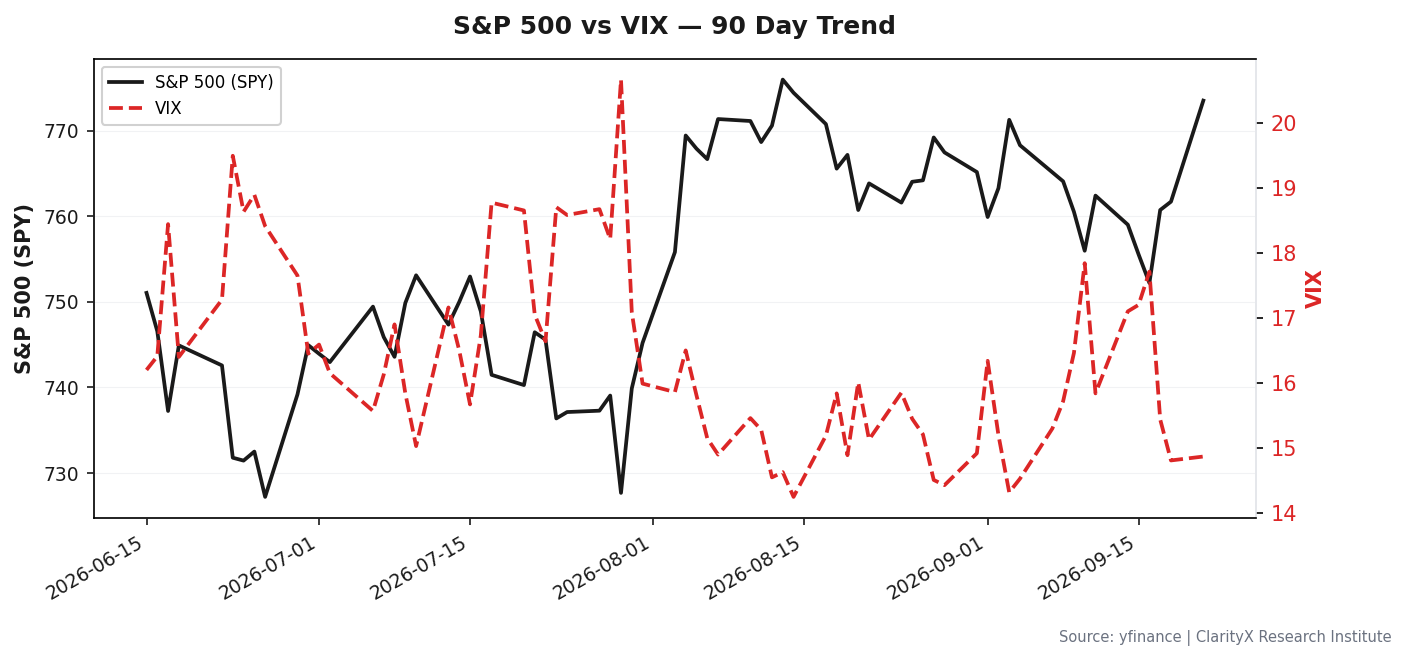 S&P 500 vs VIX — 90 Day Trend
Skyworks is up 33% in a month. Adobe is down 32% on the year. Two semiconductor-adjacent names, two opposite verdicts from the same market, in the same four weeks. I open with that pair not because I have a view on either stock — I don't — but because it is the cleanest illustration of the problem I want to put in front of you this week. The regime call is genuinely in question. Not "uncertain" in the lazy sense that every week is uncertain. In question, with two credible reads of the same data set competing for the label, and the engine's own confidence sitting at 43.9% on STAGFLATION.
Start with what actually moved. WTI is $89.74, down from $101.47 six days ago. That is an 11.6% collapse in the crude print in one week, and it is the single largest input change in the payload. High-Yield OAS tightened to 2.68% — the engine records that as tighter by 232 basis points versus the prior week's 5.00%, which is the kind of move that normally ends arguments rather than starts them. VIX at 14.81, down from 17.20. The 10y-3m spread is +0.79pp and steepening. Gold at $4,001. Weekly claims at 206,000, still 30,500 below the 236,500 threshold that would tell me the labor market is cracking.
Read One: the inflation impulse is fading. Oil down 11.6% removes the cost-push leg. Credit is wide-open — 2.68% HY OAS is not a stress number, it is a complacency number. Volatility is priced for calm. On this read, the STAGFLATION label is a lagging artifact of a shock that is already unwinding, and the 14% forward probability of a rotation toward Goldilocks is too low.
Read Two: nothing real has changed. Wage growth at 3.09% is sticky. Inflation sits 1.7 standard deviations above its historical average — the engine flags this as the dominant bearish driver, and it is the only signal with a non-zero conviction attached. The curve is steepening at +0.79pp, which historically is not a growth signal but a term-premium signal. Housing permits at Z = -0.62, 1,394k annualized, weakening. The LEI is unavailable — value 0, YoY 0.0%, status UNAVAILABLE — so I have no forward-looking composite to break the tie, and I will not pretend otherwise. On this read, cheaper oil is demand destruction dressed as relief.
Here is my honest position: I lean Read Two, but only barely, and the 43.9% confidence is the correct expression of that. Last week I carried 40.8% on the same label and told you the low number was the most honest output we had. It is now 43.9% — a 3.1-point drift, not a conviction. If you are waiting for this model to resolve the question for you, you will be waiting past the point where the answer is tradeable.
What the ambiguity does to positioning is more useful than the label itself. The equity anchor holds at 62.0%, cash 9.0%, gold 10.0%, defensive shift 0%, urgency MONITORING. The engine made minimal tilt adjustments this week and I am not going to manufacture a rotation the data does not support. There is no sector-level signal in this payload — no breadth, no relative strength, no performance dispersion field. What I can tell you is index-level: the S&P at 7,763.9 sits 7.95% above its 200-day moving average of 7,192.3. That is a market priced for the benign read. If Read Two is correct, that gap closes, and it closes through the higher-multiple end of the book first.
So the tilt I would carry into this ambiguity is quality and pricing power over duration-sensitive growth — not because I have a rotation signal, but because that is the position that survives both reads. If oil keeps falling and Goldilocks arrives, quality participates. If oil was discounting demand and stagflation is real, quality defends. Real-asset ballast stays funded from the bond bucket, not from equity. Gold at $4,001 has done its job.
What I'm Doing
Holding the anchor at 62.0% equity. No defensive shift. Within equity, tilting toward quality, value, and pricing-power names and away from long-duration growth — the cohort that carries the 7.95% extension above the 200-day. Real-asset ballast funded from bonds, not equity. Monitoring, not acting.
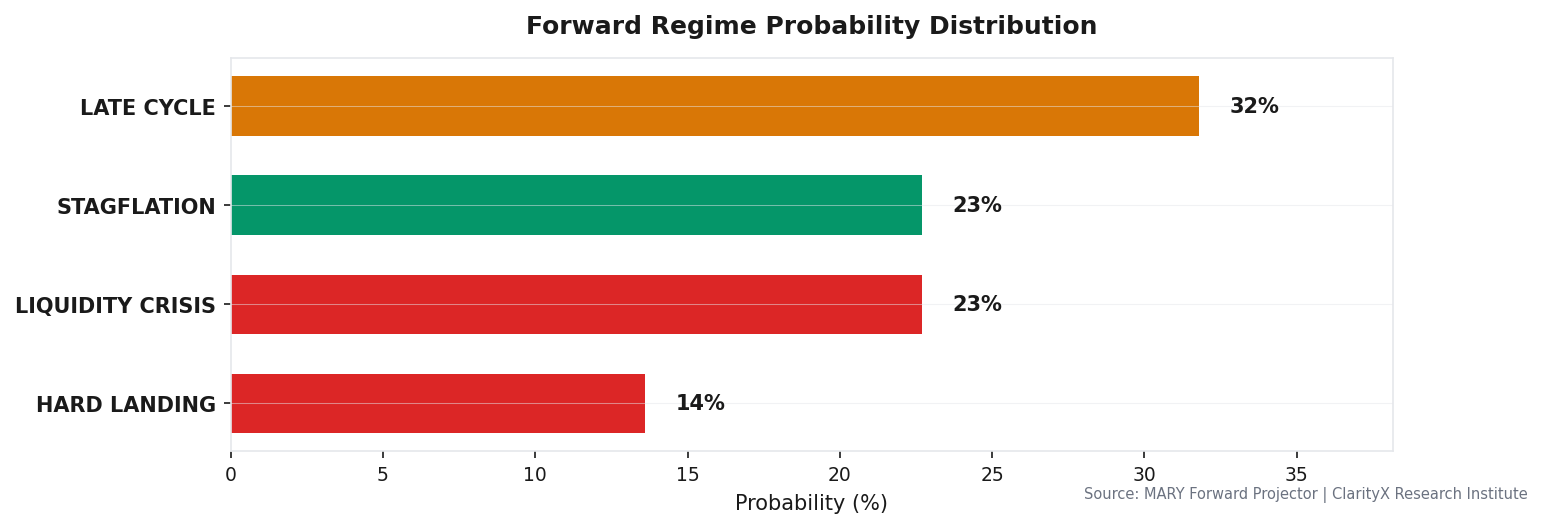 Forward Regime Probability Distribution
What Would Change My Mind
If VIX crosses 35.0, that is a volatility regime break, not a dip — I would rotate further within equity toward low-volatility and quality, and add gold and TIPS ballast funded from the bond bucket. The equity anchor does not move.
If High-Yield OAS breaks 5.0% — from 2.68% today, so 232 basis points of widening — credit is confirming the stagflation read and I would rotate within equity to defensive value and pricing power, funding additional real-asset ballast from bonds. I would not sell equity into it; I would rebalance toward the anchor.
If weekly jobless claims exceed 236,500 — from 206,000 today — the labor leg of Read Two is confirmed and wage-growth stickiness becomes a demand problem, not a cost problem. Same action: within-equity tilt to quality and low-vol, bond-funded ballast. The anchor holds.
Levels that matter: VIX 14.81 · WTI $89.74 · HY OAS 2.68% · Weekly jobless claims 206,000 · 10Y real yield 2.68% · Gold $4,001 · 10y-3m spread +0.79pp
For the full signal dashboard, allocation table, and watch list, see this week's CIO Weekly →
Get this research delivered
New analysis, directly to your inbox. Research notifications only.