Weekly Macro Report
Macro Brief — September 16, 2026
Oil at $101 is the dominant variable, and credit has not confirmed it yet.
Parson Tang — September 16, 2026Powered by MARY
Oil is back above $100 and the tanker rates are screaming. That is the print that matters this week, and it is the reason the regime label reads STAGFLATION at 41.3% confidence — a number low enough that I want to be honest with you about what it does and does not mean.
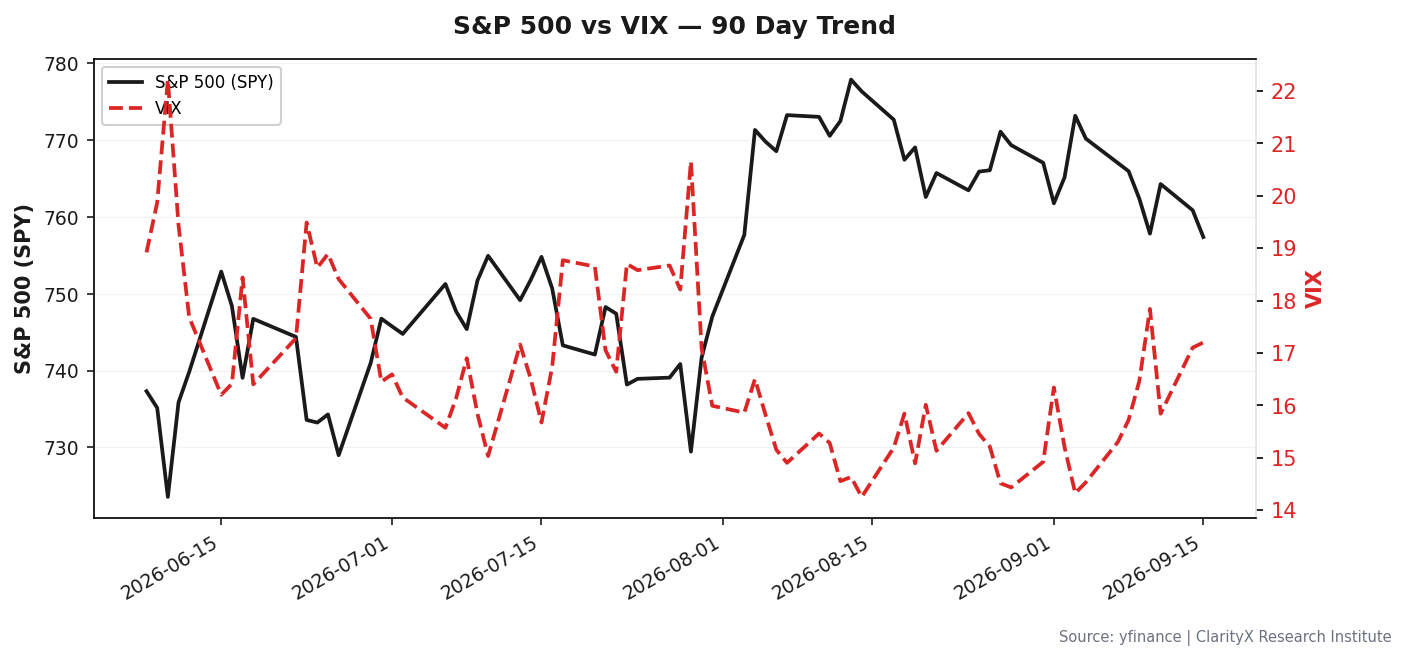 S&P 500 vs VIX — 90 Day Trend
Let me start with the honest part. My prior brief carried a 40.8% confidence reading on the same STAGFLATION label, and I told you that low number was "the most honest output we have." Three weeks later it is 41.3%. That is not a vindication; it is a coin flip that has decided to keep spinning. When confidence sits this close to the midpoint, the label is a description of the last six months, not a forecast of the next six. I am not going to pretend otherwise.
What has changed is the energy input. WTI at $101.47 is the dominant variable now, up from $82.17 in that prior card, and the transmission mechanism is mechanical and slow. An oil shock hits the pump first, consumer confidence second, and CPI last — with a six-to-ten week lag before it shows up in the headline print. So the sequence to watch is not the CPI number you already have (as of August, and stale by 47 days). It is the confidence surveys and the gasoline receipts over the next month. By the time CPI confirms the pass-through, the equity market will have already repriced the margin story.
That margin story is where the sector rotation signal earns its keep. The engine flags DEFENSIVE_ROTATION, but read the internals carefully: Energy is the number one leader, joined by health care and financials, while cyclicals and rate-sensitives lag. That is not a classic defensive tape — that is the signature of stagflation. In a genuine growth scare, energy leads for a week and then hands off to staples and utilities. Here, energy is leading because the input cost is the story, and the companies that own the molecule are the ones with pricing power. Meanwhile, the firms that consume energy — transports, chemicals, discretionary — are the ones absorbing the squeeze.
Now the credit picture, and this is the number I want you watching. High-Yield OAS sits at 2.76%, wider by six basis points from 2.70% the prior week. That is a drift, not a break — and at 2.76% the market is still priced for a benign default environment. The distance to the 5.0% stress trigger is 224 basis points, which is a lot of room. But credit is the tell for oil shocks: if energy costs start pressuring leveraged borrowers in the consumer and industrials complex, HY OAS is where it shows up first, well before equity volatility does.
On the labor side, weekly initial jobless claims came in at 206,000, still comfortably below the 236,500 stress threshold. Wage growth at 3.15% is not re-accelerating. The 10-year real yield at 2.62% is the number that matters for duration, and the curve at +0.87pp (10y-3m, steepening, z of +1.34) is doing what a stagflation curve does — steepening from the front as the market prices sticky inflation against a slowing real economy. Housing permits at 1,433k annualized, z of +0.25, are stable and unremarkable, which is itself a small mercy.
What I'm Doing
The equity anchor holds at 62%. Nothing in this week’s data justifies moving it. Within equity, the tilt is toward the pricing-power cohort the rotation signal is already flagging: energy, health care, financials over transports, chemicals, and long-duration discretionary. The bond bucket funds the ballast — I want gold and TIPS doing the inflation-hedge work, not cash sitting idle earning a real yield that inflation is quietly eroding. Gold at $3,941 is the validation of that stance, not a reason to chase it.
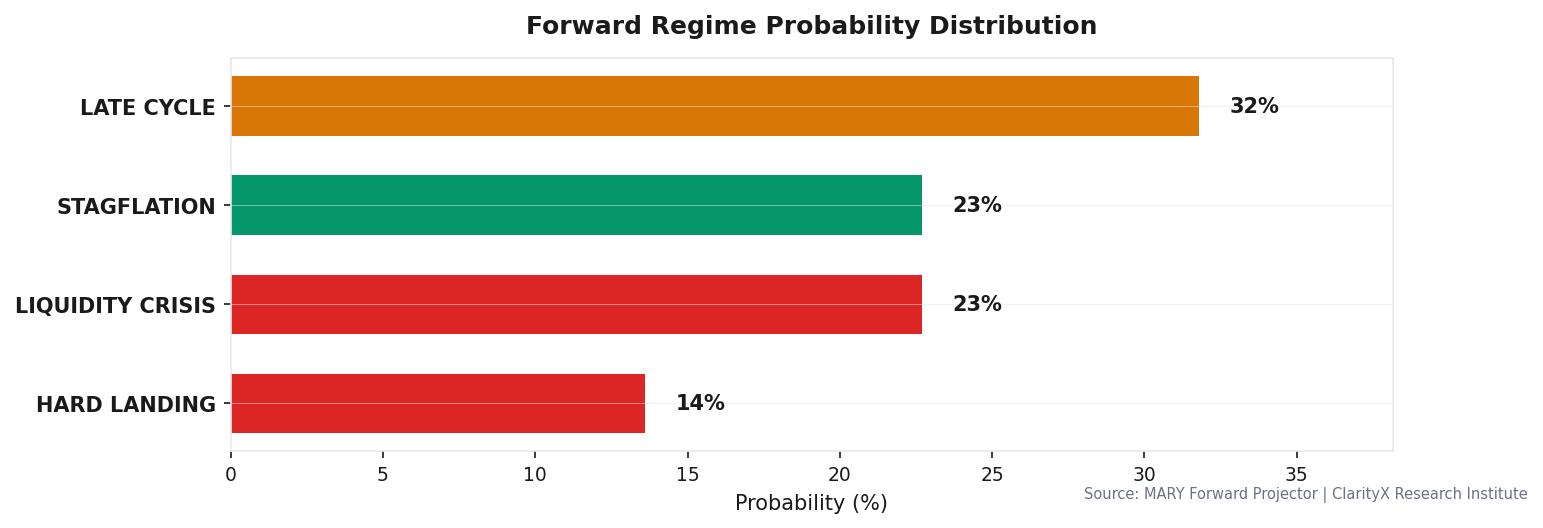 Forward Regime Probability Distribution
What Would Change My Mind
If VIX crosses 35, that is not an exit signal — the anchor stays at 62%. The action is a within-equity rotation harder into low-volatility and quality names with demonstrated pricing power, funded by trimming the cyclical and rate-sensitive sleeve, with the bond bucket adding to gold and TIPS.
If High-Yield OAS breaks 5.0% — 224 basis points from here — that is a credit event, not an equity event. The action is to rotate within equity toward balance-sheet quality and away from leveraged small caps, and to fund additional TIPS and real-asset ballast from the bond bucket. The equity percentage does not move.
If weekly initial jobless claims exceed 236,500, the labor crack is real and the stagflation label gains confidence. The action is a within-equity tilt toward defensive quality and low-volatility, with the bond bucket adding duration and gold. Again — the anchor holds.
Levels that matter: VIX 17.20 · WTI $101.47 · HY OAS 2.76% · Weekly jobless claims 206,000 · 10Y real yield 2.62% · Gold $3,941 · 10y-3m spread +0.87pp
For the full signal dashboard, allocation table, and watch list, see this week's CIO Weekly →
Get this research delivered
New analysis, directly to your inbox. Research notifications only.