Weekly Macro Report
Macro Brief — June 27, 2026
As tech stocks bleed and oil crashes, a record $1 trillion ETF is now 40% tech—trapped between falling demand and rising inflation.
Parson Tang — June 27, 2026Powered by MARY
Initial claims dropped to 215,000, oil fell nearly $10 to $70.24, and consumer confidence slid another five points to 44.8 — yet the S&P 500 ended the week lower on a rotation out of tech and AI plays, not a broad-based risk-off move. That divergence is the story this week. The regime remains STAGFLATION, but confidence dropped from 51% to 44.8%, and the model disagreement between our rules-based and ML signals is now the dominant variable. One sees a disinflationary growth scare; the other sees inflation that won't die. Both can't be right, and the market is starting to price that tension by rotating within equities rather than exiting them.
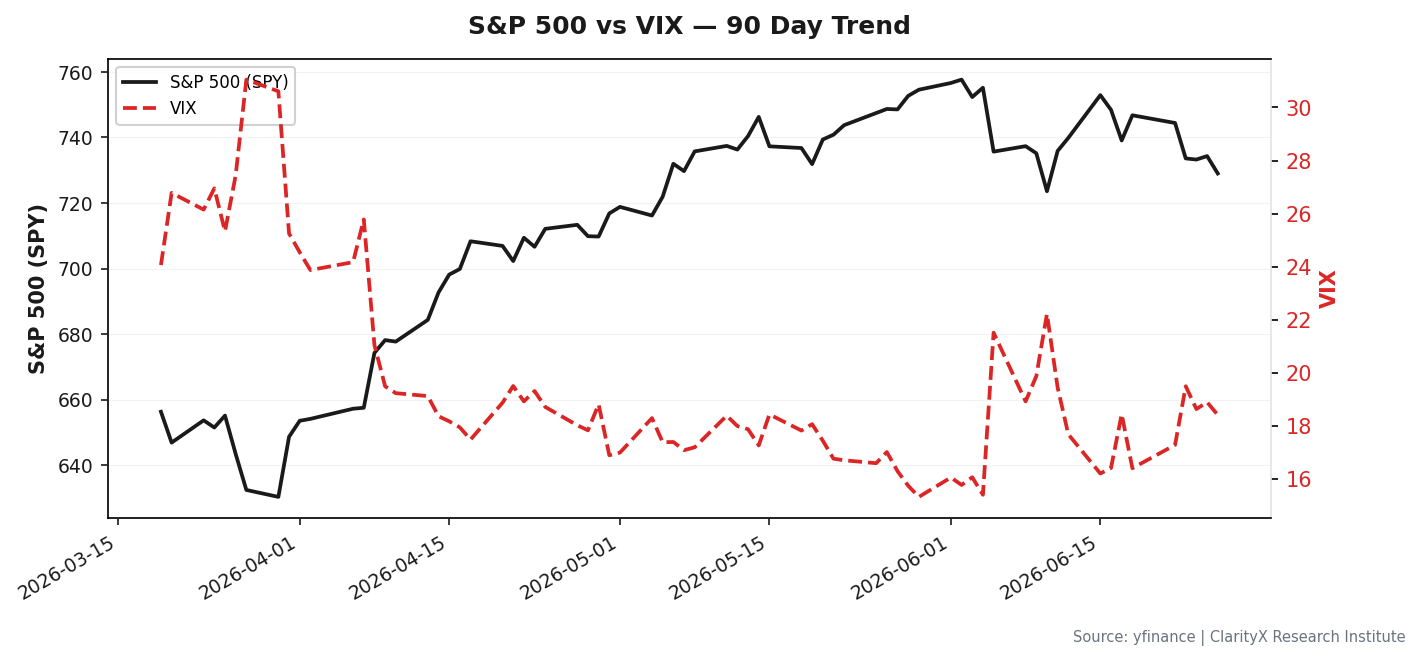 S&P 500 vs VIX — 90 Day Trend
The oil move is the cleanest signal. WTI at $70.24 is down 12% from last week's $79.91 — a $9.67 drop that should be a tailwind for consumer spending and input costs. But CPI rose to 4.27% and PCE to 3.77%, both accelerating from last month. The market is correctly interpreting this as a demand-side slowdown, not a supply-side reprieve. Consumer confidence at 44.8 is now at levels that historically precede recession, yet weekly jobless claims at 215,000 remain 9.1% below the 236,500 stress threshold. The labor market is still holding — barely.
The rotation out of tech and into value, quality, and low-vol is the transmission mechanism I'm watching most closely. VOO hit $1 trillion in AUM, but nearly 40% of it is now tech. That concentration risk is unwinding in real time. The VIX fell to 18.63 — lower than last week's 19.44 — which tells me this is not a fear-driven exodus. It's a deliberate, orderly repositioning. The forward risk summary puts a 32% probability on LATE_CYCLE in 3-6 months, and that feels about right. We're not in crisis. We're in a slow grind toward one, and the market is front-running it.
The credit market is not confirming the equity rotation yet. High-Yield OAS is at 4.13%, still 87 basis points from the 5.0% stress threshold. BAA-10Y is at 0.94%, well inside the danger zone. This is the tension that keeps me at MONITORING rather than DEFENSIVE. If credit widens meaningfully, the equity rotation will accelerate into a full de-risk. If it holds, this is just a sector rotation within a strategic equity anchor.
The trip wire signal in the crisis regime shows 0 CRITICAL and 1 WARNING. That warning triggers a de-risk expressed within equity — rotate to value, quality, low-vol — but the equity allocation holds at the strategic anchor. That's exactly what I'm doing. No cash raise. No gold increase. Just sector rotation inside the equity sleeve.
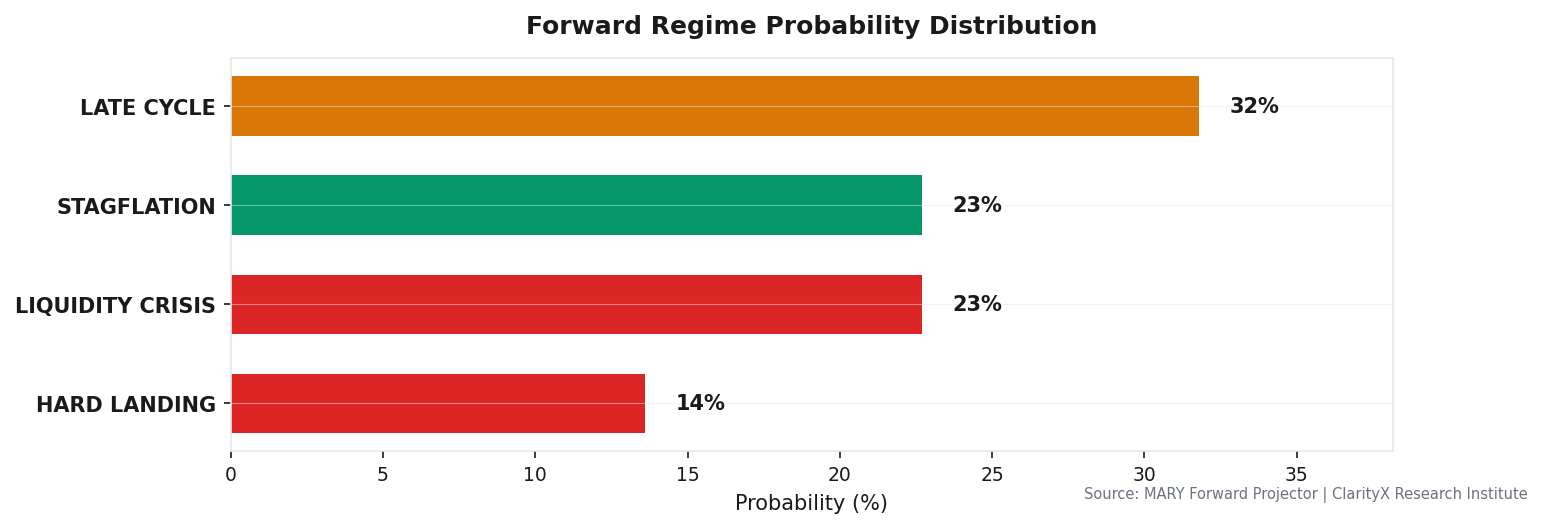 Forward Regime Probability Distribution
What Would Change My Mind
First, if High-Yield OAS breaks above 5.0%, I will reduce equity beta by cutting the strategic anchor from 59% to 50% and moving the 9% into cash. That is the credit confirmation that the equity rotation was a canary, not a rotation.
Second, if weekly jobless claims cross 236,500, I will shift from MONITORING to DEFENSIVE, raising cash from 12% to 18% and cutting equity from 59% to 53%. A weakening labor market in a stagflation regime is the most dangerous combination.
Third, if the VIX closes above 35, I will execute the full crisis protocol: equity to 45%, cash to 25%, gold to 15%. That level would signal that the orderly rotation has broken into disorderly liquidation.
Levels that matter: WTI $70.24 · VIX 18.63 · HY OAS 4.13% · Weekly jobless claims 215,000 · 10Y real yield 2.06%
For the full signal dashboard, allocation table, and watch list, see this week's CIO Weekly →
Get this research delivered
New analysis, directly to your inbox. Research notifications only.