CIO Weekly Intelligence Report
CIO Weekly Intelligence Report — October 05, 2026
CONTESTED: Stagflation vs Goldilocks — Forward (within-axis): 14% chance conditions rotate toward Goldilocks; 100%…
For the analytical argument, read this week's Macro Brief →
The Macro Brief argues the regime call is genuinely in question — two credible readings of the same tape — and that conclusion is exactly why this week's letter is about the contest itself. Here is the full signal picture and what we're doing about it.
The Verdict
Regime: STAGFLATION (contested) | Confidence: 42.7% | Forward Risk: STABLE
Conviction tagline: "The label held, the conviction didn't — and that gap is the trade."
I am not going to tell you we are in Stagflation with conviction. The engine's top label is Stagflation at 42.7% confidence — down 3.2 points from 45.9% last week — with Goldilocks as the credible second read. That is the fourth consecutive week below 50% and the sixteenth consecutive report week the label has held since June 13. Sixteen weeks of persistence against falling certainty is a specific setup: the label has duration but not conviction, which means it can flip on one print without the underlying economy having changed much at all.
What actually moved this week was Gold — up $203.45, from $3,934 to $4,138, the largest move in the entire signal set — against a downgrade in the regime call. When the model loses confidence in its own label while the market's oldest inflation hedge reprices violently higher, the honest read is not that the regime changed. It is that two credible interpretations are now in play, and the contest is the call.
First-time reader? MARY is our 16-signal regime scoring engine. It reads economic data weekly and maps conditions to historical regimes using 105 economic snapshots from 1990–2026. Confidence = how certain we are of the regime label. Probability = likelihood of a future scenario. Never swap the two.
The Evidence
Gold is the story, and it is telling two stories at once. Up $203.45 to $4,137.55, gold is doing exactly what it should in a stagflationary regime — Consumer Price Index (CPI) sits at 3.71% and core Personal Consumption Expenditures (PCE) at 3.70%, both unchanged week-over-week, both well above target, with West Texas Intermediate (WTI) crude at $90.18. But gold is also the classic hedge against a loss of confidence in the policy framework itself. The engine cannot distinguish between those two motives, and neither can I. What I can say is that a $200 weekly move in the hedge asset is not noise.
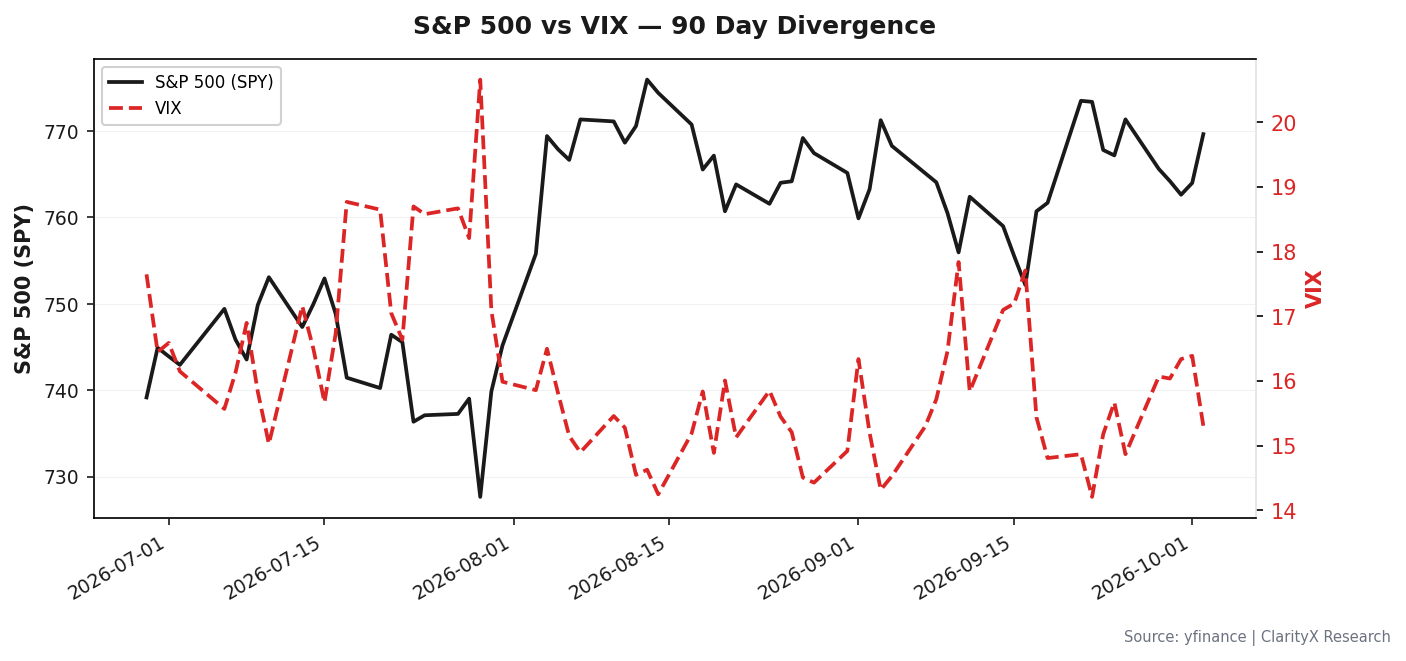
The Goldilocks read got a little stronger, not weaker. Financial conditions remain genuinely easy — the National Financial Conditions Index (NFCI) at -0.548, well inside accommodative territory. Volatility ticked up to 15.31 from 14.21, but that is still a low absolute level, and the VIX is 56.3% away from the 35.0 Stage 1 trigger — closer than last week's 59.4%, which is the wrong direction. Credit is tight but not stressed: the High-Yield Option-Adjusted Spread (HY OAS) — the extra yield below-investment-grade corporates pay over Treasuries — sits at 3.10%, 38% away from the 5.0% Stage 2 trigger. If you weight financial conditions over the gold print, you get a benign read. I am not going to pretend that away.
Consumer confidence is the signal that contradicts the Goldilocks case, and it is worth resolving. Confidence fell to 51.70 from 55.20 — a 3.5-point drop, the second-largest move this week. Easy financial conditions and falling consumer confidence do not usually coexist unless households are reading something the credit markets are not. That divergence is why I lean toward the Stagflation read even as the engine's confidence falls: the real economy signals are weakening while the financial signals stay calm, and that is the pattern that precedes a repricing, not a soft landing.
| Signal | Value | vs. Last Week | What It Means |
|---|---|---|---|
| Gold | $4,137.55 | ↑ +$203.45 (worse) | 10% |
| Consumer Confidence | 51.70 | ↓ -3.50 (worse) | Households weakening while credit stays calm — the divergence that matters |
| VIX | 15.31 | ↑ +1.10 (worse) | Still low, but moving the wrong way and now 56.3% from the Stage 1 trigger |
| Oil (WTI) | $90.18 | ↓ -$3.34 (better) | Slight relief on the inflation input, but still elevated at $90 |
| Yield Curve (z-score) | +2.07 | ↑ +0.50 (worse) | Steepening hard — 1.3 standard deviations above average, a late-cycle tell |
Where Are We Heading?
The forward numbers are three independent reads, each on its own axis. They are not rivals in one race and they do not sum to 100%.
- Cycle phase (business-cycle axis): 100% chance the phase resolves toward LATE_CYCLE. This is a directional read, not a forecast of a crash — the cycle is late, and late cycles resolve.
- Growth × inflation quadrant (quadrant axis): 14.3% chance conditions rotate toward GOLDILOCKS. The phase resolves into this quadrant; it is not competing with the cycle read.
- Stress overlay (relative-risk axis): ~36.4% transition-mass toward LIQUIDITY_CRISIS or HARD_LANDING per the 3–6 month regime-transition model. This is a relative risk that can strike any state — not a calibrated crash probability.
These are historical base rates — the observed frequency of each transition across dated historical episodes from this regime, Bayesian-smoothed. They do not move when this week's signals move; they change only when the regime label changes or the historical record is extended.
Trip wire status: 0 critical, 0 warning. All five triggers are live and none are close.
| # | Trigger | Current | Distance | Action |
|---|---|---|---|---|
| 1 | VIX > 35.0 for 3 consecutive days | 15.31 | 56.3% away | Execute Stage 1 entry |
| 2 | High-Yield OAS > 5.0% | 3.10% | 38.0% away | Execute Stage 2 entry |
| 3 | Initial jobless claims (weekly) > 236,500 | 206,000 | 12.9% away | Tilt within equity to quality/low-vol; add bond-funded ballast |
| 4 | NFCI > -0.429 | -0.548 | 27.7% away | Tighten financial conditions flag |
| 5 | MARY confirms HARD_LANDING or LIQUIDITY_CRISIS | STAGFLATION | — | Full crisis allocation |
What Does History Say?
The engine returned no historical analog for these conditions. Zero matches across 105 economic snapshots spanning 1990–2026. That is itself information: the current combination — gold repricing violently higher, consumer confidence falling, credit spreads tight, financial conditions easy, and the regime label contested — does not have a clean precedent in the record.
When there is no analog, the honest posture is to lean on the process rather than the pattern. The process says: the label is contested, the confidence is falling, and the one asset that hedges both inflation and policy uncertainty is moving. That is not a setup that rewards conviction. It rewards patience and optionality.
The Entry Question
Where are we in the drawdown? The engine returned no current SPY drawdown reading this week, so I cannot place us on the gauge. What I can say is that with VIX at 15.31 and HY OAS at 3.10%, we are nowhere near the levels that have historically marked entry points. The fear is not here yet.
Staged entry framework:
- Stage 1 — VIX > 35.0. Trigger: panic. Why this moment: the VIX does not reach 35 in calm markets; it reaches 35 when forced selling is underway. That is when the marginal seller is exhausted. Action: deploy the first tranche.
- Stage 2 — High-Yield Option-Adjusted Spread > 5.0%. Trigger: credit stress. Why this moment: HY OAS at 5.0% means the credit market is pricing real default risk, not a growth scare. That is when equity prices have already absorbed the bad news. Action: deploy the second tranche.
"The instinct to buy the dip is strongest when the dip is only half done. With VIX at 15 and credit spreads at 3.10%, the dip has not started. Preserving optionality is the position."
Sector Rotation & Strategy
The signal tilts this week push +4.4% toward equity, driven by two opposing forces: inflation 1.7 standard deviations above average (bearish for duration-sensitive sectors) and the yield curve 1.3 standard deviations above average (bullish for cyclicals and financials). The net is a modest equity overweight funded from bonds and cash — not a risk-on call, a rebalancing.
On strategy: the registry holds no measured per-regime win rates for STAGFLATION, so there is no measured basis for conviction here. The registry's carried-over preference — unmeasured in this regime — is mean reversion and CANSLIM/Weinstein. Mean reversion carries a validated backtest outside this regime (8.54% CAGR, 0.39 Sharpe on Mag6, 2020–2024) and works best in range-bound, late-cycle markets, which is where the cycle-phase read places us. I am not going to dress an unmeasured preference as a conviction call.
The Portfolio
| Asset | Current Regime (STAGFLATION) | Target Regime (GOLDILOCKS) | Recommended Now |
|---|---|---|---|
| Equity | 60% | 85% | 64% |
| Bonds | 6% | 3% | 0% |
| REITs | 2% | 6% | 2% |
| Commodities | 8% | 2% | 8% |
| Gold | 10% | 1% | 10% |
| TIPS | 6% | 1% | 6% |
| Intl Bonds | 2% | 1% | 2% |
| Cash | 6% | 1% | 8% |
| Total | 100% | 100% | 100% |
The equity anchor holds at 64% — above the 60% strategic anchor, funded from bonds (cut to zero) and cash (raised to 8%). This is the SAA-holds-in-crisis logic: in stagflation, earnings can still grow with prices, so selling equity locks in multiple compression without capturing the inflation-driven revenue. The de-risk is a within-equity tilt to pricing-power and quality, plus the real-asset ballast (commodities, gold, TIPS) that already sits at 24% of the book.
Contradiction bridge: equity above 50% alongside a cautious macro read is not a contradiction — it is the stagflation playbook. You do not sell equity into inflation; you tilt it and hedge it. The hedge is the 24% real-asset sleeve, not a bond allocation.
The Watch List
- VIX > 35.0 for 3 consecutive days (current: 15.31, 56.3% away) → execute Stage 1 entry.
- High-Yield Option-Adjusted Spread > 5.0% (current: 3.10%, 38.0% away) → execute Stage 2 entry.
- Initial jobless claims (weekly) > 236,500 (current: 206,000, 12.9% away) → tilt within equity to quality/low-vol; add bond-funded ballast. The equity anchor holds.
- NFCI > -0.429 (current: -0.548, 27.7% away) → tighten financial conditions flag.
- MARY confirms regime shift to HARD_LANDING or LIQUIDITY_CRISIS → full crisis allocation.
Options overlay: No position. VIX at 15.3 offers no fear premium to sell and no greed setup to buy. Options alpha comes from timing regime transitions; with no transition signal, there is no edge. Stay patient.
Data as of October 05, 2026. Sources: FRED, CBOE, University of Michigan, OECD. MARY engine: regime scoring engine with historical analog matching. This is not investment advice — it is a decision framework built on data.
Get this research delivered
New analysis, directly to your inbox. Research notifications only.